
Umbilical cord blood as a future transfusion product for extremely premature infants
All our donors are over 18 years old. Naturally. But is adult blood truly suitable for the tiniest of patients?

Researchers from Erasmus MC and Sanquin have identified a link between blood transfusions using adult donor blood and two conditions that frequently occur in extremely premature infants.
Because the blood of these premature infants differs in several respects from adult donor blood, we are investigating whether umbilical cord blood from healthy, full-term infants could serve as an alternative. This blood contains fetal hemoglobin, the same type of hemoglobin naturally present in the blood of extremely premature infants. Research indicates that babies with a higher proportion of fetal hemoglobin are less likely to develop these conditions. Consequently, umbilical cord blood may be a more suitable alternative for premature infants who require transfusions.
Encouraging results
Through the Pre-Cord study, we at Sanquin are investigating whether umbilical cord blood can be safely collected, processed, and stored for use in transfusions. In close collaboration with Erasmus MC and LUMC, we have collected large quantities of cord blood to study the optimal conditions for its processing and storage. The initial results are very encouraging and will be published soon.
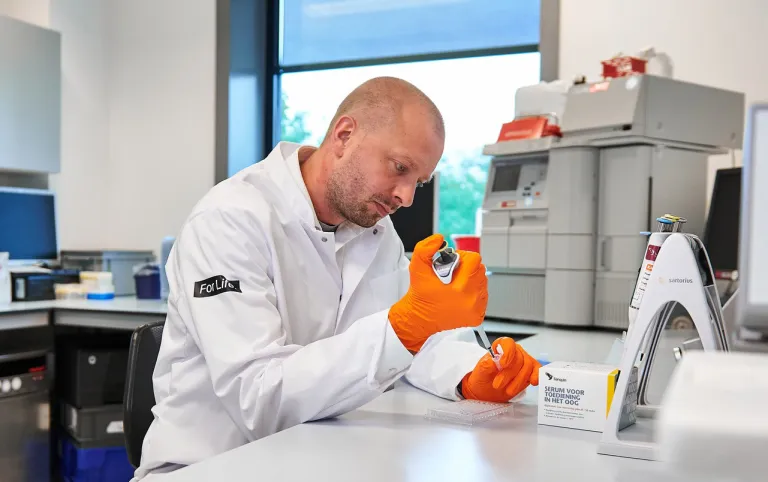
Thomas Klei, head of Product and Process Development (PPO) at Sanquin and involved in the study, explains: “In our lab, we are working hard to find a solution to effectively collect, anticoagulate, process, and store umbilical cord blood. This is no simple task, as existing bag systems and filters are designed to handle the large volumes typical of adult blood donations, which leads to a significant loss of cord blood.”
Furthermore, the volumes of cord blood collected vary considerably, which complicates reproducibility. Additionally, red blood cells from cord blood have proven to be less stable during storage. “Producing a high-quality product from umbilical cord blood is a challenge, certainly, but it is by no means impossible,” says Klei.
A single cord blood donation is sufficient for one transfusion.
The use of umbilical cord blood for transfusions in extremely premature infants is becoming an increasingly viable prospect. A single cord blood donation is enough for one transfusion. How wonderful it would be if cord blood, currently left unused, could soon contribute to the care of extremely premature babies?
Actueel

Caring for people and the planet together
