
Thesis Lisan Kuijper
On 25 March 2026 Sanquin researcher Lisan Kuijper defended her PhD thesis 'Charting the B Cell Landscape: Unraveling human antigen-specific B cell responses to infection and vaccination' at the University of Amsterdam
Promotor: Prof SM van Ham
Copromotor: A ten Brinke PhD
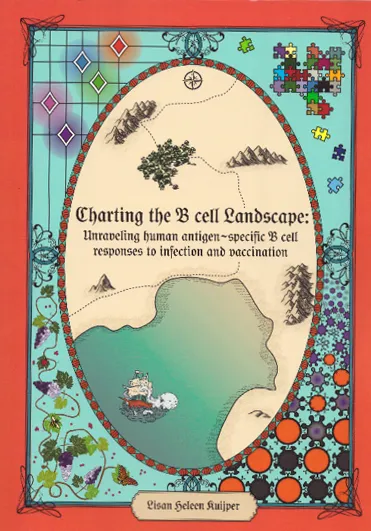
This thesis investigates B cell responses to SARS CoV 2 infection and mRNA vaccination in healthy individuals and in patients receiving immunosuppressive therapy. The adaptive immune system relies on B cells that differentiate into memory B cells (MBCs) or antibody secreting cells (ASCs), although recently more B cell subsets have been discovered and studied in further detail. Generally, B cell differentiation can follow the germinal center (GC) route, which induces affinity maturation, or a faster extrafollicular (EF) route.
Chapters 2 and 3 provide deep phenotyping of B cell responses after SARS CoV 2 infection. A prominently enriched IgG+ CD71+ CD27+ activated B cell (ActBC) population was identified, representing a potential precursor state between ASCs and MBCs. Subtypes were distinguished based on CD86, CD73 and CD24 expression, revealing differences between newly generated versus long lived resting MBCs. Furthermore, individuals with stable antibody levels showed lower IgG+ MBC frequencies compared to those with declining antibodies, suggesting differences in GC output or timing of the response.
Chapters 4–7 describe B cell dynamics after SARS CoV 2 mRNA vaccination. Early responses were dominated by ActBCs, ASCs and DN2 cells, whereas IgG+ MBCs predominated after six months. We also find a population of CD11c+ ActBCs. Somatic hypermutation analyses indicated that both CD11c+ and CD11c– ActBCs are highly mutated and show clonal overlap with GC derived MBCs. Interestingly, in patients treated with TNF inhibitors, GC dependent B cell populations were reduced, while CD11c+ EF associated cells remained intact. SARS CoV 2 vaccination also triggered transient polyclonal “bystander activation” of B cells specific for unrelated pathogens such as Influenza, TT and RSV.
Overall, the thesis highlights the power of detailed phenotyping to uncover the variety in B cell responses after infection and vaccination, and advances our understanding of B cell differentiation.
Chapters
Chapter 1
General introduction 1
Chapter 2
Deep profiling of B cells responding to various pathogens 18 uncovers compartments in IgG memory B cell and antibody-secreting lineages abstract
Chapter 3
Longevity of antibody responses is associated with distinct 61 antigen-specific B cell subsets early after infection abstract
Chapter 4
Heterogenous activated B cell compartments arising early 99 and transiently after antigen exposure
Chapter 5
Clonal Relatedness Between B Cell Phenotypic Subsets: 132 Using Multimodal Single-cell Analysis of Antigen-specific B Cells to Delineate B cell Evolution
Chapter 6
TNF inhibitors affect the induction and maintenance of 174 spike-specific B cell responses after mRNA vaccination abstract
Chapter 7
SARS-CoV-2 mRNA vaccination leads to transient humoral 202 and B cell bystander responses in adults abstract
Chapter 8
General discussion
Download
Download thesis from university repository (when available)